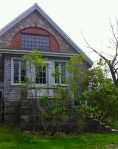
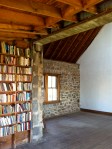
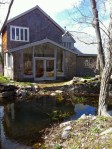
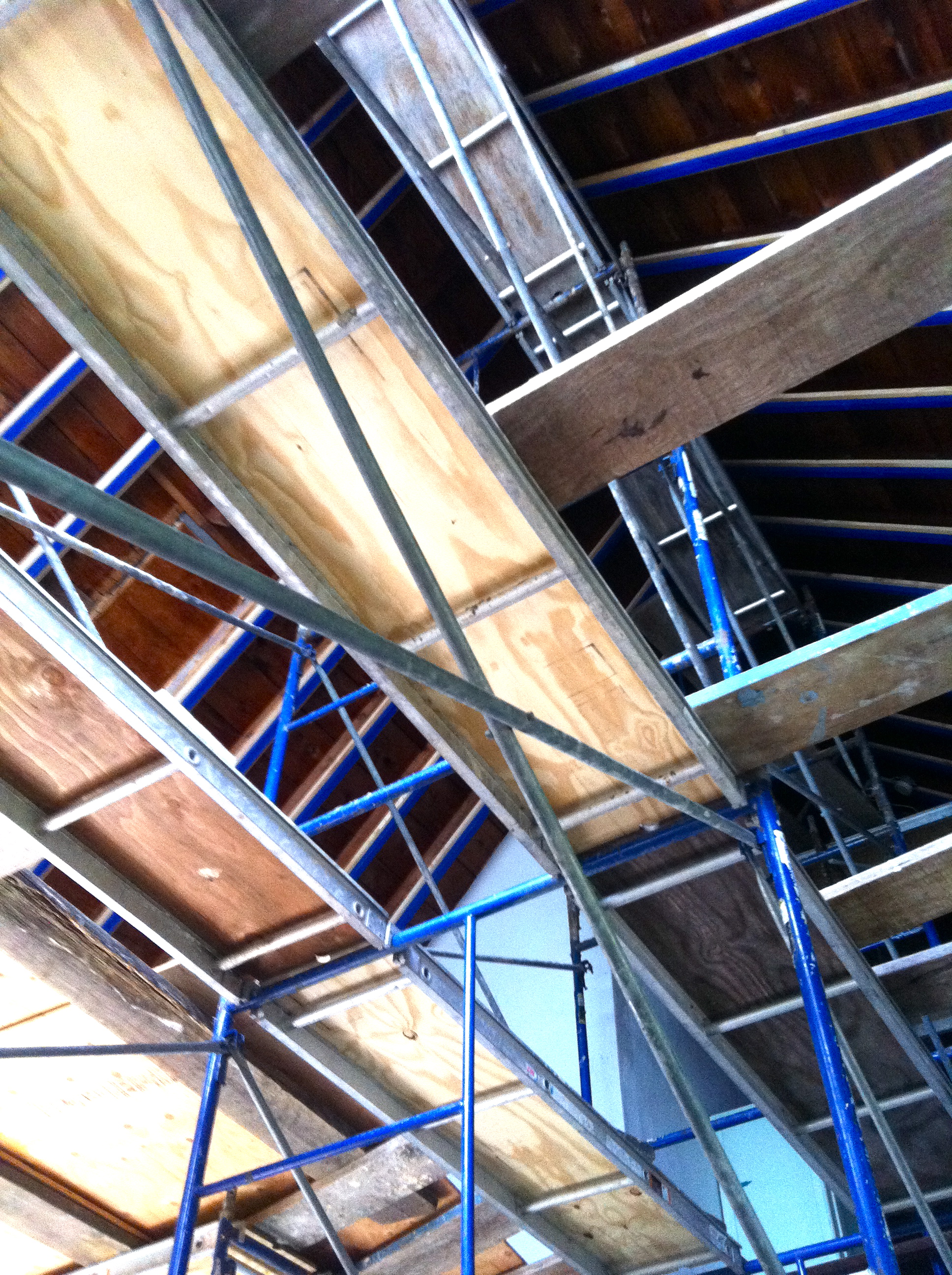
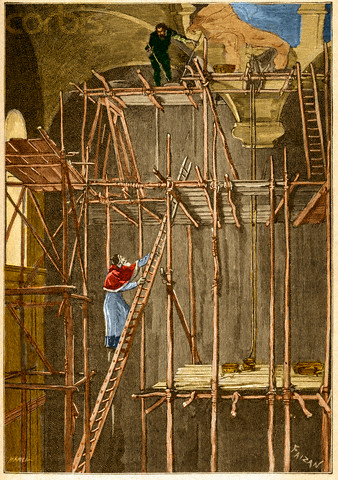
The work in the studio, the jewel-in-the-crown room at Howlets, is in full swing. Our goal is to make the studio comfortable year-round by adding heat and insulation. Because much of the work is planned for the ceiling, 26 feet above the floor, there was no question we needed a staging structure of which Michelangelo would have been proud. Unlike Michelangelo and his helpers, most of the work on the staging in the studio will not be done lying down.
Walk the plank

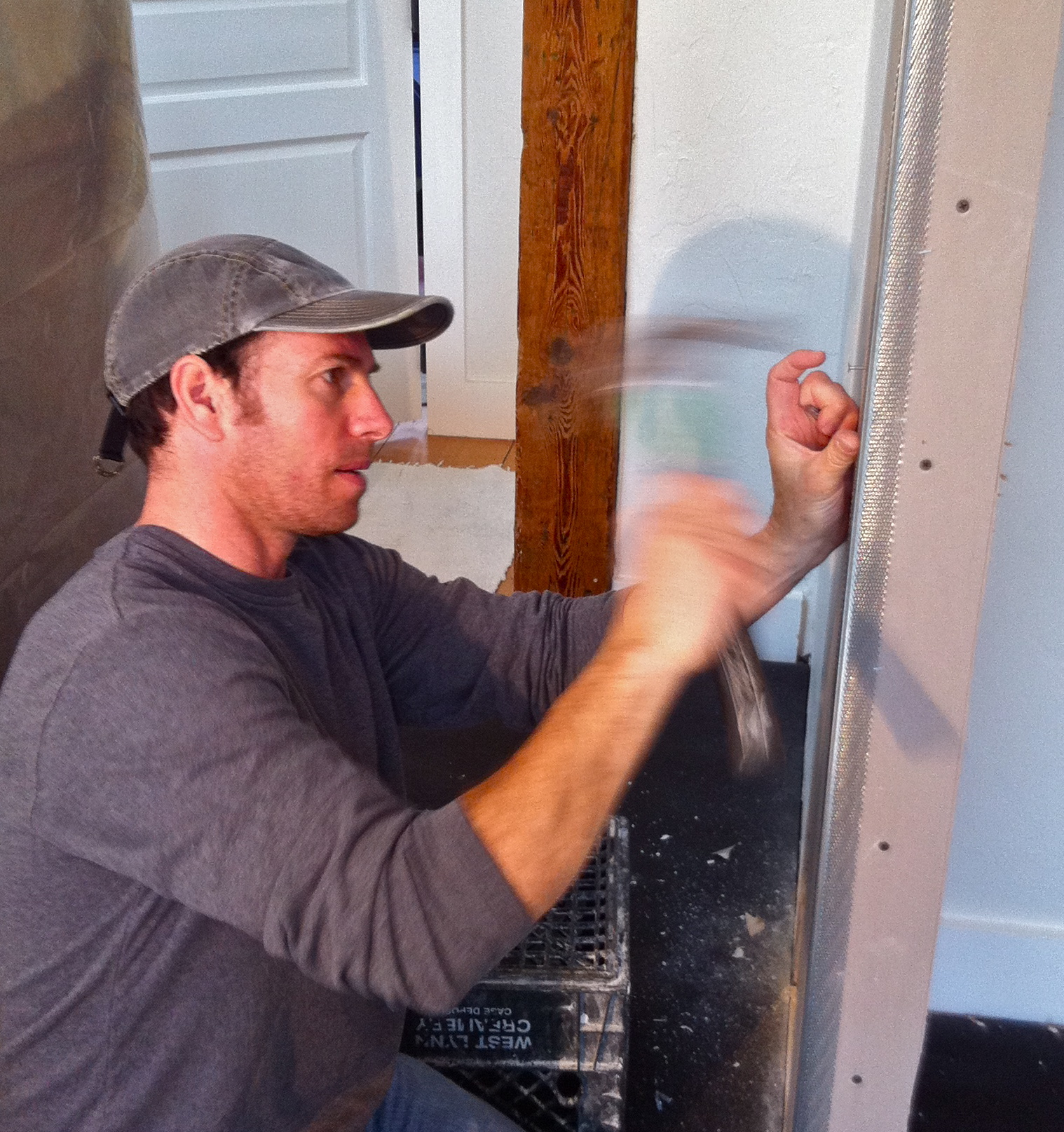
Because the staging is rented only until August 28, the clock is ticking. In all, the staging will be used for six different projects. Jim Fritz of Fritz Carpentry, the general contractor, will use it first to tape off the rafters and nail strips for the sheetrock to be applied. Steve, the electrician from Noble Electric, will run the wiring for the ceiling fan, smoke and fire detectors, lighting and a heat exchange thermostat. March and Martin will then use the staging to spray insulation between the rafters. Jim will use it again to fasten the sheetrock to the strips. Enos Painting will paint the sheetrock a crisp ceiling white. Finally, Jim will remove the protective tape to reveal a soaring 100-year old ceiling with all of the modern conveyances hidden behind the insulation and sheetrock. Between each rafter, soft lights from below will sweep up to the ridge pole line.
An infallible check of the work

Completing all this work by August 28 will be a challenge. The music that keeps playing in my head is the music from the scene in Fantasia, the sorcerer’s apprentice. Faster and faster the proverbial buckets of water need to be emptied. As the deadline draws near, the music plays faster. Did Michelangelo feel this pressure from Pope Julius II (known as “il papa terribile”)? Luckily for Michelangelo, the Pope’s staging was probably not rented from Lynn Ladder and Scaffolding with a strict return date.

Click on any photo to enlarge

First impression

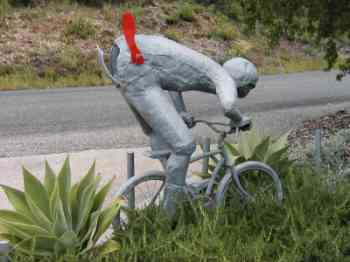
When choosing a new mailbox, what do you consider? Is it big enough to hold the voluminous amounts of bills that arrive on a monotonous basis? Does it have a red flag to pull upright to signal the letter carrier (this is the gender-neutral term now, but I admit I miss “mailman”) that you have an outgoing letter? Does it have a separate compartment for a small package, magazines or bulky catalogs? Is your mail so important (state secret important) that it requires a lock with a key?

These are the decisions that must be made when you get a notice from the post office that your mailbox “needs attention.” In all fairness, the post office was correct: the old mailbox at Howlets was listing to starboard and reeled drunkenly on its post when the sticky flap door was jerked open. The previous owner’s name was on the side of the box in large reflective peel-and-stick letters that had been battered by storms and bleached by the sun. It’s time had past.

The old mailbox had to go, but replaced with what? Mailboxes are usually placed at the end of the driveway or walkway and are the first thing you see when entering a property. First time guests look for the street number. A mailbox is the first impression formed by visitors to your house. What does your mailbox say about you? When discussing all of these considerations with Heather, one of the owners of Howlets, she just asked that the mailbox be utilitarian and distinctive and put the final decision in my hands. A search and destroy mission ensued for the perfect Zen balance, form and function. Searching on the internet for mailboxes was a lesson in the copious amounts of choices we have as Americans. A few of the choices that were scrupulously considered but eventually rejected are shown below.

Special delivery

What message does this send?

In thinking about mailboxes and the current electronic age, I wondered about the future of the existence of mailboxes at all. Will mailboxes have the same demise as the hand written thank you note written on your personalized, engraved, cream-colored Crane’s stationery? Most thank you notes now come in the form of an email — efficient, immediate and admittedly sometimes clever. The time it takes to hand write a thank you note is sadly not an efficient use of time in our harried lives. Writing in your best Palmer method script, injecting just the correct amount of thanks without sounding effusive, finding the recipients’ street address, buying the stamp, licking the envelope (yuk) and taking it to the post office (or raising the red flag on your mailbox, if you have one), all take way too much time and effort. But they sure are nice to receive. Wish I could say the same for bills, either paper or electronic.

At Grey Gardens, our mailbox choice was made easier by the fact that we had a stone wall in which to embed it. We wanted to make the mailbox disappear in the wall and make a non-statement. Only our mailman knows where it is.

Disappearing act

Click on any photo to enlarge

Ellen Day Hale painting

As we face all the drilling and (soon) blasting of the ledge to accommodate the new septic system and buried power lines, granite and its sheer stubbornness keep coming to mind. Howlets is built almost entirely of the stone on which it sits. When the house was built in 1911, the stone was quarried from what was to become the basement (surface ledge extraction method) and a quarry directly behind the house (pit quarry extraction method). The walls are double in depth, meaning that the stone that is on the outside is not the stone that appears on the inside. In other words, nuclear blast strong. A good thing, as the Seabrook  power plant sits just across Ipswich Bay. While Howlets was being built, Ellen Day Hale, the painter who built Howlets, set up an easel and painted the work in progress. The painting just hints at the massive undertaking. In the painting, there are seven masons at work on the foundation, each wearing a hat — broad-brimmed hats, newspaper boy-style caps, and (in the case of the crane operator) a kind of scull cap. Millinery fashion at the job site.

Hundred year marks

To cut granite into the desired shape truly takes an artist’s touch. There is a grain that runs through granite which dictates the way in which it will cleave when “cut.” The stone mason eyes and feels the stone to find the grain. To the undeveloped eye (mine), the stone looks like a big freckled blob that just sits there defying you. Just picking it up to move it is a backbreaking task, let alone trying to shape it into a piece that will fit snugly against another. A plug-and-feather method of splitting the stone was most likely employed. A series of holes is drilled into the stone along the “fault” line (an invisible version of the San Andreas fault) and then feathers driven into those holes to split the stone. The name “feather” for a tool used to split stone is ironic and perfect. The granite facade of Howlets bears the marks that the plug and feather method leaves behind. The brute strength and delicate touch to work the stone brings to mind a Sumo wrestler performing a ballet, beautifully.

There are some additional stone features at Howlets that are subtly elegant. The window sills are made of granite and each one has a slight cant to the sill to allow rain water and melting snow to drain away from the window frame. This detailing is normally seen in wood, which sculpts to the hand a bit easier than stone. The lines are even and straight with an architectural block detail at the end of each sill.

Heavy art

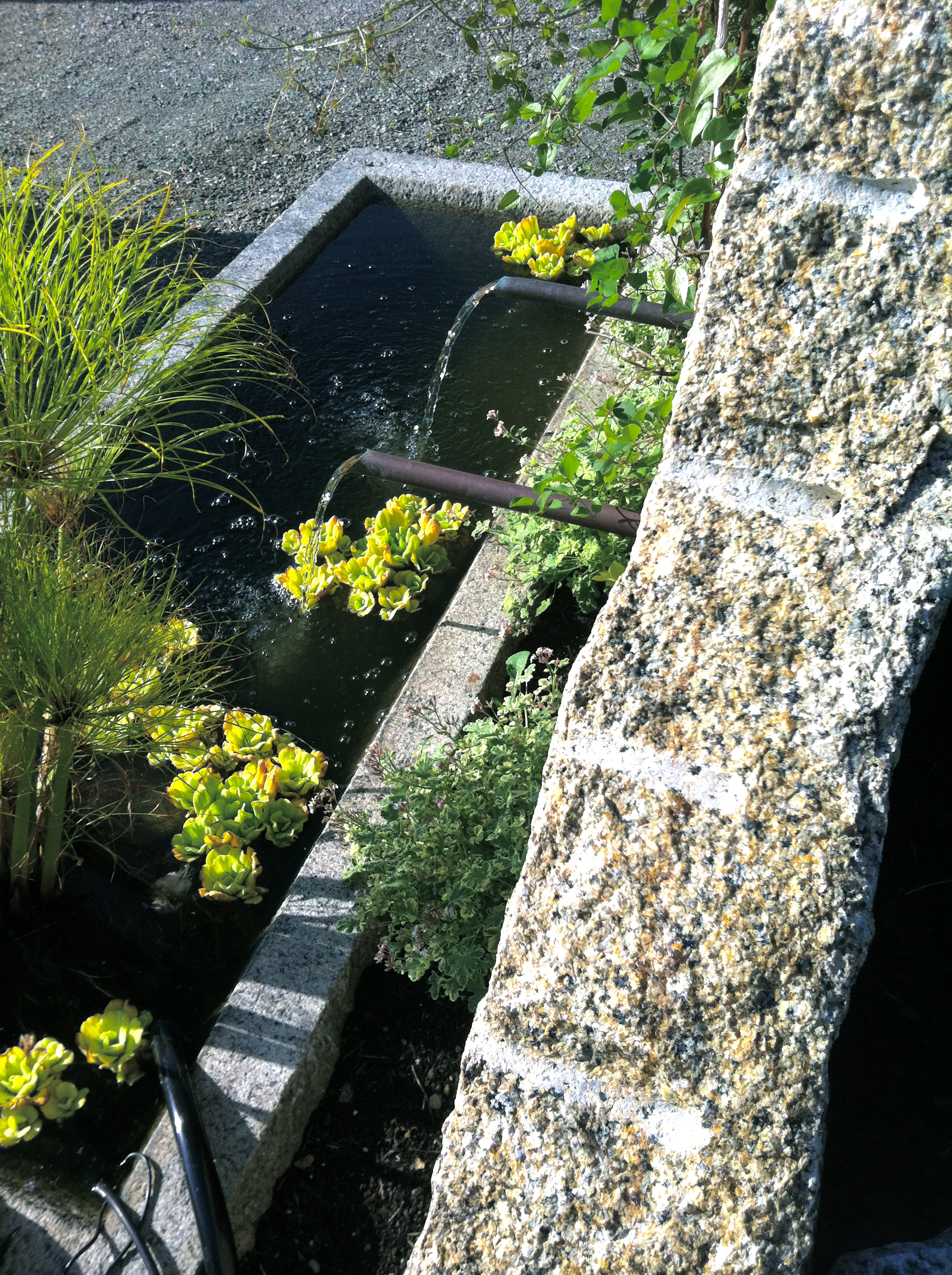
Same marks, eight months oldAt our own house Grey Gardens, we recently had a back piece made in order to add water spouts for a long abandoned water trough that was on the property. The marks left by the cleaving process eight months ago on the back piece are the same marks as the stone at Howlets, made 100 years ago. The water trough itself, with an engraved date of 1862, is made from one huge piece of granite  about the size of a large bathtub. There are no plug and feather marks on the trough, as they were removed with a chisel. It resembles a finished  piece of furniture, all of granite.
I take some satisfaction in the fact that Cape Ann’s glorious stone work will be here long after the nuclear age has passed into history.

Click on any photo to enlarge.

Laying of the trans-Atlantic cable

The work at Howlets is moving forward, alternating between lightning speed and a snail’s pace. The carpenters have re-worked the master bedroom entry and closets, creating a much better flow and more closet space, and the upstairs bathroom is outfitted with a perfect new double-sink vanity and new softly veined grey Carrera marble tile. However, the digging up of the front yard — to install a new septic system and bring new electric service to the house — is proving epic. The ledge upon which the house sits is unforgiving and requires drilling and even blasting to make headway. In order to blast, surveys of the houses within 250 feet must be conducted, to ensure that no harm is done. All are feeling like we are midway through the 12 labors of Hercules, complete with the odors of the Augean stables.

"Come closer my dear, the better to see you"

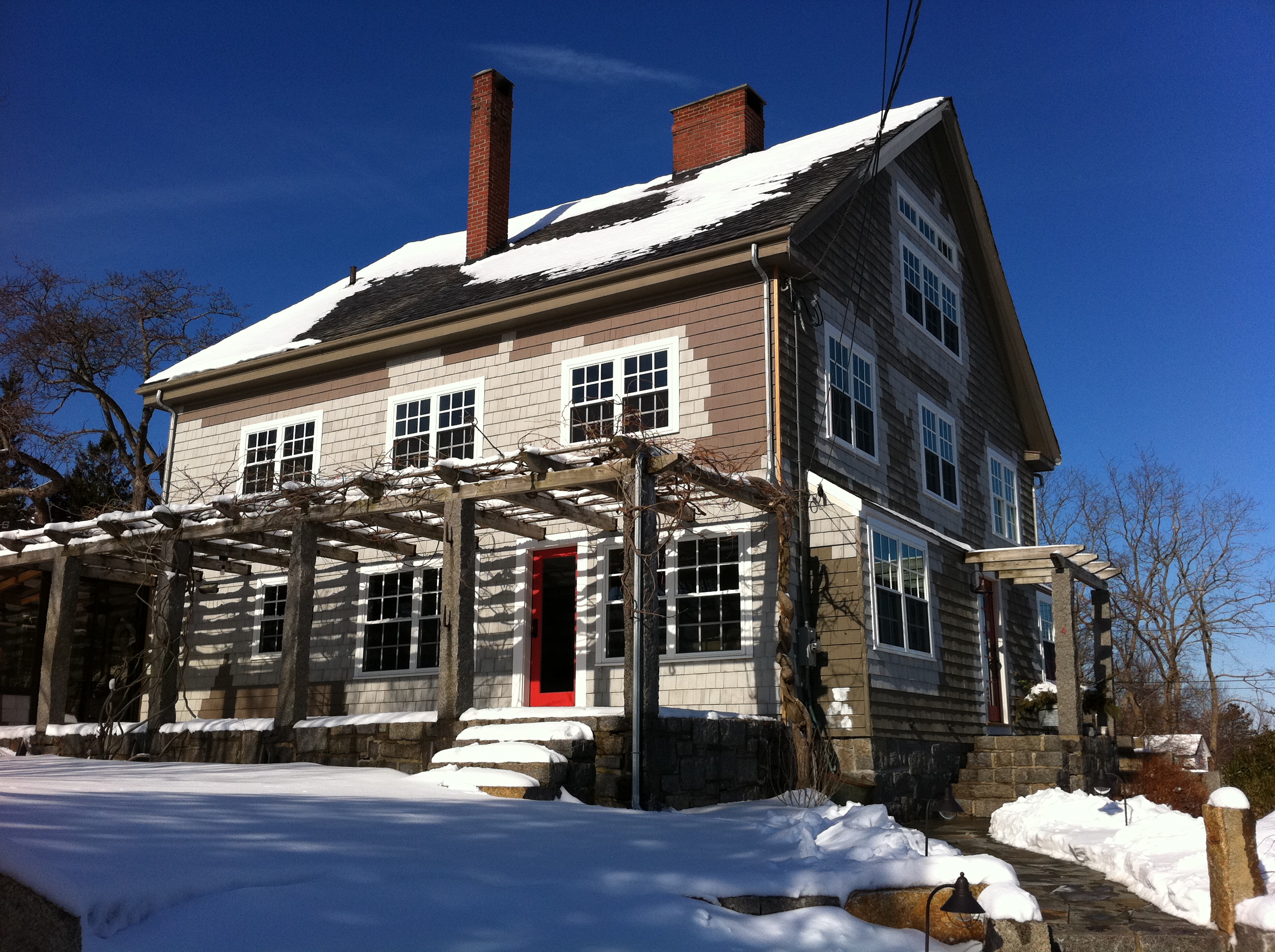
As a diversion from that drama, and to borrow again from Greek mythology, I thought I’d recount my own personal version of Sisyphus’s task. Rather than roll a rock up a hill, only to have it roll back down, I clip wisteria vine with almost the same effect. When my partner and I first considered purchasing our home Grey Gardens, as we call it, the wisteria vine on the pergola had already firmly wrapped itself around the electric meter and pulled it completely off the building.  The vine was initiating an assault on the gutters and downspouts. Buying the house anyway (why not take on a gargantuan renovation to spice life up a bit?), we knew our first and greatest task would be taming the wisteria beast.

Woody vices

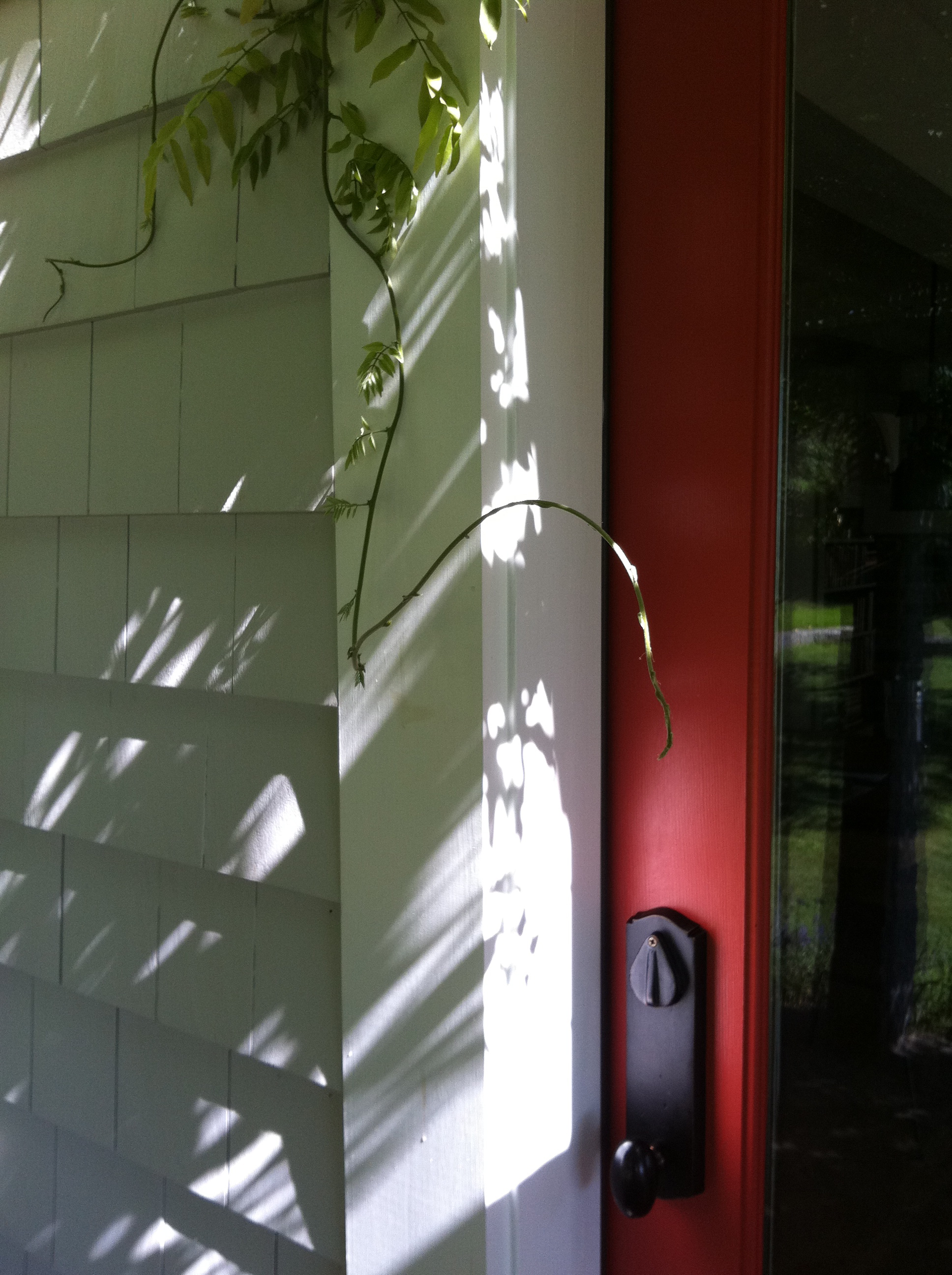
Appropriately called “the destroyer of castles,” wisteria will dig its tender tendrils into any crevice, eventually become a woody vice and pull down anything in its path. Aggressive seems a quaint term when used to describe this invader. When researching the care of wisteria, the experts recommend trimming it twice a year, once severely in the winter (cutting each branch back to just three buds from the main trunk) and then again in the summer to remove the long “whippy things” that seem to appear overnight. We have found this prune-twice-a-year advice wildly tame. If you sit still, this vine will wrap itself around your throat in the time it takes to have a glass of wine at sunset or read the morning paper. I just finished clipping the seemingly benign soft curling tendrils from the downspouts. I am sure they would have pulled them off the house by bedtime if I had not been vigilant.

Tendril awaits an unsuspecting victim

All that being said, this wisteria graces the porch beautifully. Our stone porch with pergola faces the south; the shade the vine provides in summer is a welcome relief from the hot sun. In the winter, with all the foliage fallen, the sun beams in the dining room and kitchen windows. The sculptural nature of the vines in contrast with the stone pillars on the pergola never ceases to catch the eye. Wisteria has its brief but oh so glorious bloom in May, when festoons of flowers cascade down. There are two varieties of Wisteria here, a purple version and a pink one. They intertwine unsegregated for a “I feel like I am in Tuscany” experience.

The advice literature also describes cutting the roots back in order to encourage blooming. We have not had to do this yet, but in a sadistic way we are looking forward to the task. This is a plant that thrives on abuse. Do you fight the urge to kick the cat or yell at loved ones after a bad day? Simply grab the garden tools and cut, hack, slash, sever, trim, dig, snip, clip, prune. The wisteria vine loves your heaped on abuse. It even thanks you for it and gives you flowers. Dr. Phil could not come up with a better remedy for anger management.

Purple and pink festoons

This post is a complete departure from design, decor, or renovation. It is about a slice of life on Folly Cove. On Father’s Day, Heather and daughters gave David a rowboat christened “Howlet” to putter around Folly Cove. The plan was to launch the boat from a series of large flat rocks that stair step down to the sea, just below and to the left of the house. The boat arrived with much fan fare and excitement all around. With some sunny days earlier this week, the family put the boat to good use, a perfect diversion for the out-of-school-for-the-summer teens. While their daughters were given instructions about the use of the boat, the lesson about the phenomenon of tides seems to have been forgotten.

The vagabond vessel

On a recent foggy morning, David rose early to go for a quick fishing trip before work, only to discover that the boat was missing.  Had it been stolen, taken for a joy ride or washed out to sea?  Turns out the tide had carried it across the cove and lodged it on the rocky shoreline. David and Heather brainstormed about the boat’s retrieval and, as David was now late for work, Heather was pressed into service for the rescue. The teenagers were all asleep upstairs blissfully unaware of the nautical drama. Heather briefly considered waking them and having them swim in the frigid North Atlantic waters to retrieve the boat, but her maternal instincts won out.

The dinghy had lodged in the rocks in a very private area of Folly Cove with large estates and well tended gardens sweeping down to precipitously steep rocks. With oars (and blond curls) over her shoulder, fog horns moaning in the background, she set out toward the spot where she thought she saw the baby boat wedged among the rocks. Cutting back and forth across the lawns and gardens of several estates with nervous glances up to the windows of the houses, she expected to hear a shot gun blast at any moment or at least see snarling attack dogs released from their pens to bring down the unwanted intruder.

Slip slidin' away

The boat had come to rest in a tiny, rocky, slippery inlet. Using the oars like ski poles for balance, she made her way down the steep slimy rocks and tide pools to the errant craft. Emptying the boat of water while it was being battered by the waves proved to be an awkward task. Calling upon her inner stevedore, Heather flipped the boat to empty the water, then lifted and shoved the dinghy towards the open water. After much intake of liquid into her footwear, the boat was free and she rowed against the tide across the cove to home. Another adventure experienced and mystery solved, Heather channeling Nancy Drew.

Shutters to headboard

When Howlets was built in 1911, it was the practice in Rockport to close up summer houses and studios in the Fall. Owners would shut off the summer water pipes that ran above ground, cover the furniture with dust covers, and hang solid wooden shutters over the windows to ward off the winter storms that brawl in off the sea. Howlets was no exception. When the house was opened for the season, the shutters would be removed and stored in the basement. This laborious task was most likely discontinued sometime after World War II when the price of household staff became untenable. At some point, Howlets was fitted out with a central heating system complete with cast iron radiators and glass storm windows. The on-again, off-again shutter machinations became obsolete as the house was not shut down for the winters.

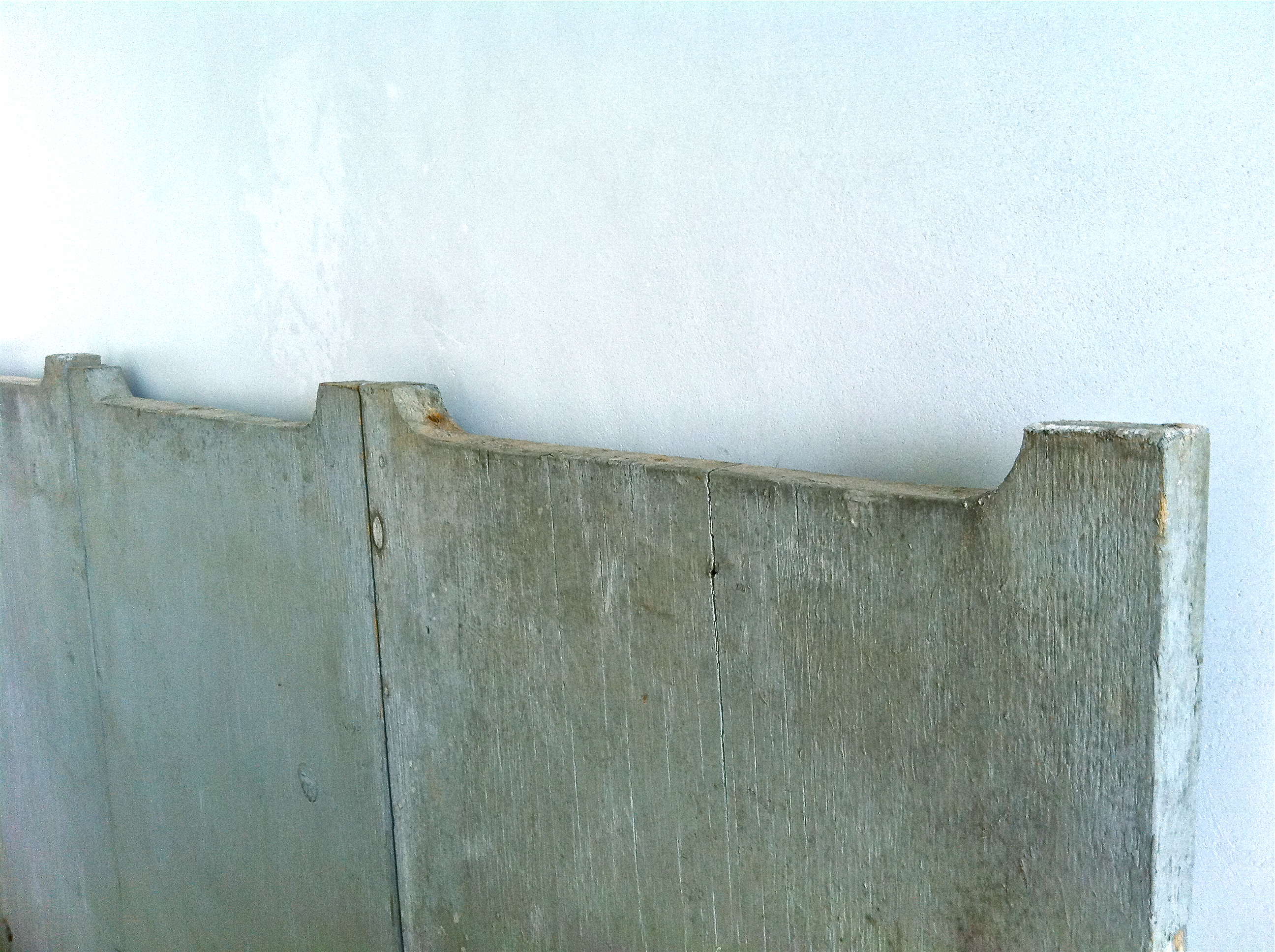
The long unused shutters sat stacked in a basement corner until last month. As David Rabin, one of the owners, and I were figuring out what to store where, we fell into a discussion about the shutters. Since there were no plans to use the shutters and they take up a lot of space in the basement, we discussed taking them to the dump. David remarked, “I hate to throw old things out.”  The rusty pistons in this brain began firing and, out of the fog, it hit me how we could re-use the shutters. The shutters have a very simple but beautiful detail at the bottom of each of the panels. When I turned them upside down, placing four side by side, a headboard appeared. The proportions are perfect for a queen size bed. When completed, the headboard will have a simple, straightforward style that also has a whisper of rough elegance.

How much more green can we get than re-utilizing an architectural piece from the past, and one originally made for the house. Re-use, recycle and reduce, indeed. After a cleaning, a light sanding and a flat finish seal coat has been applied, the shutters will be ready for their new purpose. The washed-out, weather beaten grey blue color is perfect for the color schemes planned for the house.

Count the linen thread instead of sheep

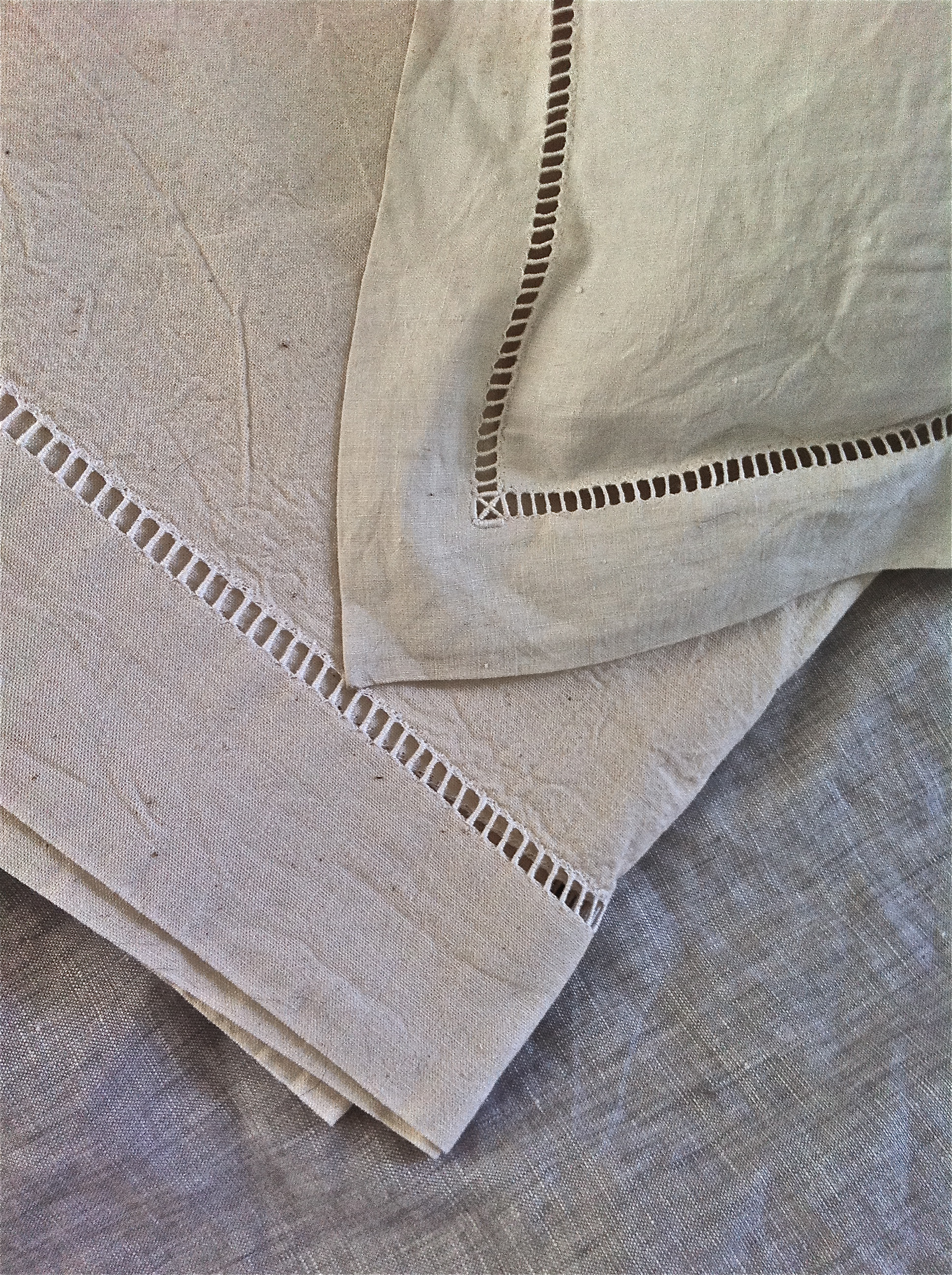
The bed will be fitted out with several different weaves and hues of linen, including a ladder stitch hemmed top sheet that we recently found from a source in France. The toile metis, fleur bleue sheet is a weave that uses linen and cotton combined and gives a heavy “down home in the French countryside” feel. The best ones are the new, “old” stock that were woven years ago and sat in a linen cupboard for years and never used. Definitely not the typical sheets that we are used to sleeping on here in the USA. Smooth and satiny is not what these sheets are about. They do have a stiff feeling to them initially. With each successive washing the fibers soften. No chemicals are used to coat the fibers to make them wrinkle proof. Nor is bleach used to brighten them to “hygiene white.” The natural color of pale wheat comes to mind. When these sheets come out of the washer, they have as many wrinkles in them as a Sharpei dog. Ironing them is an option but not necessary. Sleeping between these sheets is a wonderful retro experience. You’ll want to get up the next morning, don the farm hand clothes and begin harvesting the lavender in the fields.

Last week, my post focused on a decidedly unglamorous aspect of home restoration:  installation of a new septic system. This week, the post will explore a softer side of the process:  paint choices for Howlets.

In reading about how designers choose paint colors for their clients, I am often taken aback how little the setting and house itself are taken into account. The decisions often seem driven by the current colors du jour in the “shelter” magazines on the newsstands. For the clients and me, Howlets demanded paint colors that would fit its rocky seaside setting, granite construction and casual style. Howlets was built in 1911, 100 years old this summer, and was used as an artist’s studio and later a summer residence. It has a very simple and straightforward style, with no fancy curved moldings, plaster ceiling medallions, or affectations of any kind.

In scraping away the more recently added paint on the interior doors and wood trim, we discovered that the original colors and finishes are not shiny or glossy — nothing showy to distract the eye from the natural materials used to build the house or the setting which offers up a view across the sea to Maine. Our plan is to keep it that way. Flat or egg shell finishes for the paint are the natural choice for this house.

The dishtowel muse and new blue linen sofa

I had the chance to see the house just before all of the contents were emptied and discovered in the studio amongst piles and piles of accumulated belongings from the 100 years of living by the Hales . . . an old dishtowel. Its subtle combination of dusty blue, light grey, and linen texture spoke to me. These colors and texture just seem to fit Howlets and are going to drive our choices for paint and fabrics. The blue has a Northern European feel to it which works perfectly with the house. When Ellen Day Hale had Howlets built, she instructed Alec Jungquist, the Swedish stone mason, “to build the house to suit his own ideas, because, she said, she wanted it to look like a Northern European farmhouse.” * We plan on using a combination of hues that would feel right at home there.

Pulling the "look" together

Here is a list of some of the paint colors that we plan on using at Howlets. All are Benjamin Moore.

  • China White, flat
  • Harbor Grey, eggshell
  • Grey Owl, eggshell
  • Heather Blue, flat
Believe it or not, it is a complete coincidence that the house sits above a harbor, is named after baby owls, and one of its owners is named Heather.

* Note:  The above quote by Ellen Day Hale is taken from the book The Life in the Studio written by Nancy Hale in 1967, describing the Hales’ residency at Howlets.

Watch for next week: Is it a shutter, or a headboard?

Digging Howlets

Lest readers of this blog are under the impression that the work at Howlets will all be about the correct paint color choices and furniture placement, here is a glimpse into the less glamorous side of home restoration. For me, part of the excitement of moving into a new place is the melding of the new space with one’s own life. We want to feel “at home” and enveloped when we enter. What painting will go where, and which fabric works best on what surface, are the “sexy” decisions that are fun to make. In contrast, having the front yard dug up by a back hoe and giant jack hammers in order to put in a new septic system — because the old one does not meet code — is not high on life’s bucket list.

Here in Rockport, the thin soil surface with granite ledge just below presents challenges to placing a septic system. Test bore holes throughout the front and lower yards attest to the search for a suitable spot for it to be placed. While the holes may look as if someone was drilling for oil, no “black liquid gold” was found — only lots of ledge. It’s now looking like a significant amount of granite will have to be removed to accommodate the hole for the septic system. We’re not clear yet how much will need to go, but the large outcroppings of granite just below the soil surface that the bulldozer has exposed suggests a generous amount.

The land at Howlets has a gentle slope from the house to the sea and the desire to keep that natural grade poses a challenge. The easier, less expensive solution would be to bring in lots of soil fill, flatten out the grade, put a five foot retaining wall in, and place the septic in the flattened out area. This would give a helipad look to the front lawn. Since David and Heather, the new owners, do not plan on landing a helicopter on the front lawn, that idea was scrapped. The current plan is to disguise the septic system by sinking the septic system as low as possible (without going coal mine depth) and softening the look of the septic system by tapering the edges out.

The machines have been digging, scooping and rat-a-tat-tatting away for a week or so and the noise is deafening, nerve jangling and all around annoying.

Clara

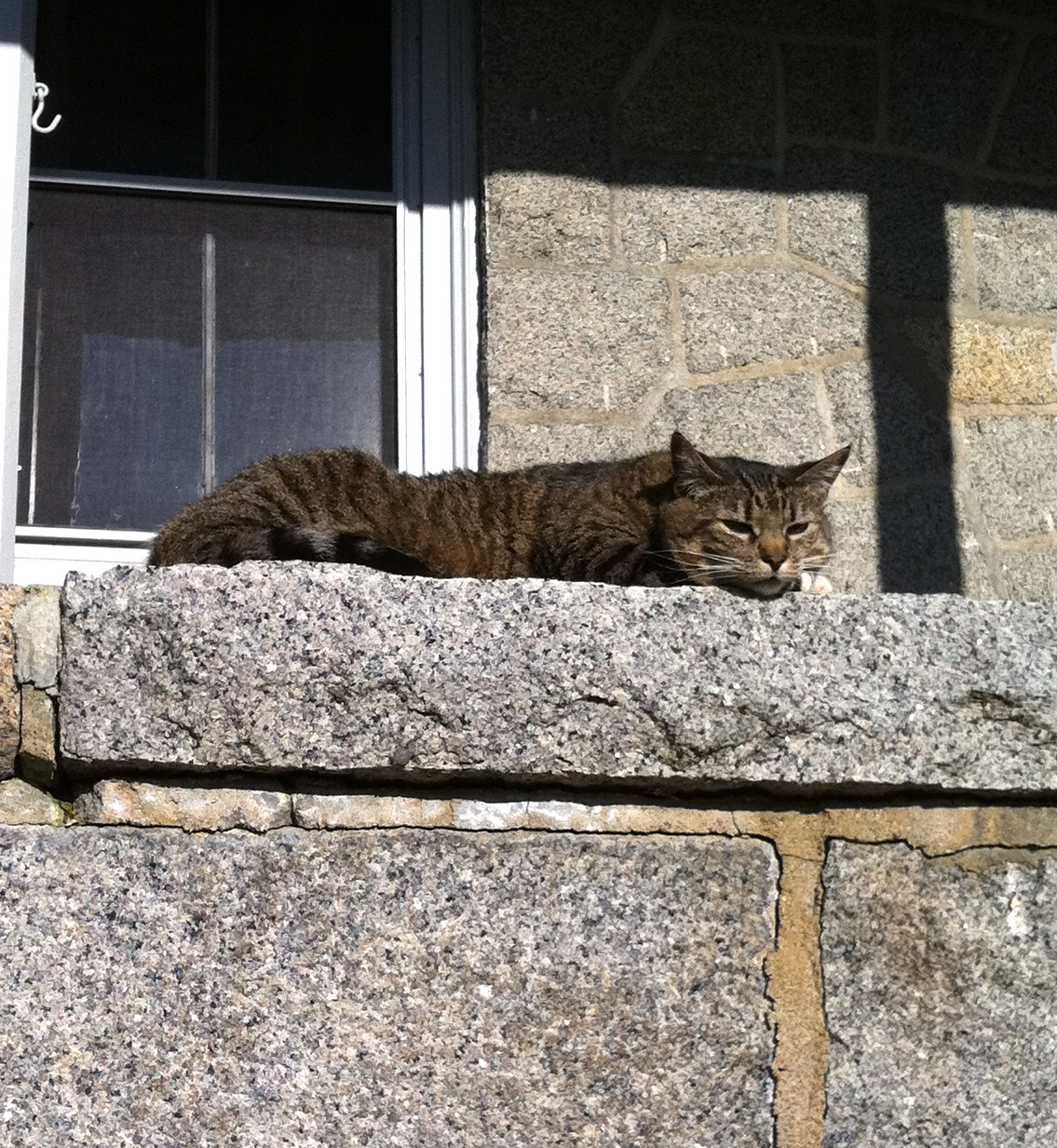
Living in the midst of a construction site must be a trial for David, Heather and family. The only one unfazed by the work is the cat Clara, who either sleeps through the racket or perches on the stone porch rail and observes.

Next week: The dish towel that spoke to me.

Our 1840s barn-turned-home, prior to paint job!

During the current remodel of our own house, an old 1840s barn, we needed some plastering work done and as a result had the pleasure of meeting Craig Moore, a plasterer.  Over the last month, Craig has been working to marry the plaster of new walls with the house’s existing rough plaster surfaces. It takes an artist’s eye and a craftsman’s hand to do it.

In the course of his work on our house, he told me of his work at Howlets years ago and his friendship with Bill Wertenbaker, the last of the Hales to own Howlets before its stewardship was recently passed to David Rabin and Heather Atwood.

He recently posted a comment on this blog recalling his association with Howlets.  I didn’t want readers to miss it, so am featuring it in this week’s post:

Congratulations to you Heather and, your family.

I am pleased to know that a well deserved curator has taken the reigns of nothing less than a true thoroughbred of a house.

I believe Bill will be happy to know that the property will be well cared for. I know Bill personally and, have spent truly, some wonderful days at the Estate while plastering many of the rooms that he tried to save from days of old, as well as the addition built out back.

For me it was a honor to have worked for someone who not only appreciated your craft but, wanted more importantly to know the man behind the craft.

We spent a good amount of time getting to know each other while looking out over the beautiful rocky coast beyond the well cared for sloping grounds.

My wife and I had the chance to become reacquainted with Bill, as we were invited by him to his farewell party.

We discussed with Bill how we all hoped that the house would go to the “right person”, as he was very proud and humble that the “Studio/House” was built for his family and, in his family only, for all these years.

There is something extra ordinary about the house, the land, the views, it all seems to encompass and hold to it’s own, the raw organic simpler ways of life that feel, well, ordinary.

Maybe that’s why it feels so extra ordinary, because we have seemed to think that we can recreate something better than what once was.

I think not.
Like a dear old friend, may that house forever be.

Thanks, Craig, for your poetic description of your memories of Bill and Howlets.

Craig Moore

Today’s post continues the photo tour of Howlets, David Rabin’s and Heather Atwood’s 1911 Cape Ann stone house. These photos focus on the house’s enormous studio and kitchen, prior to any work being done on the house.

Howlets’ studio, the jewel in the crown

The studio has witnessed one hundred years of creative energy on the part of the previous owners, the Hale family. Since it was built in 1911, Ellen Day Hale, Lillian Wescott Hale, Phillip Everett Hale, Nancy Hale and her son Bill Wertenbaker have all painted, written and created in this stunner of a room. The ceiling is 28 feet high and has an exposed wooden beam ceiling and Rockport granite walls. The original huge wood arched North-facing window blew in during a storm some years ago and the glass brick replacement, although sturdy, looks out of place. The plan is to replace the window with an Anderson which will closely resemble the 1911 original.

Kitchen with quarry

The kitchen was expanded and modernized approximately ten years ago. A wall of glass provides an intimate view of the quarry, which lies just two steps from the back door. Ducks, frogs, turkeys and deer periodically move on and off stage as if in cameo roles in a play. Removing just the hanging glass cabinet will open the space and create a long view from the living room through to the quarry.

Click on any photo to enlarge.

Coming soon:  Craig Moore, plasterer, remembers working at Howlets.